Within the MiCA Stablecoin regulatory framework, EMT (Electronic Money Token) is tied to a single fiat currency and governed by electronic money payment rules. In contrast, ART (Asset-Referenced Token) is backed by a basket of assets and is subject to more stringent capital and systemic risk management requirements. The two differ structurally in issuance qualifications, reserve composition, redemption rights, and the criteria for significant token recognition.
2026-11-04 08:14:49
Risks related to WULF stock extend beyond price volatility, arising from the interplay of the Bitcoin cycle, electricity and Hashrate costs, policy compliance requirements, market liquidity, and company performance metrics. Segmenting these risks into four primary themes—industry cycle, regulatory compliance, liquidity execution, and operational signals—enables a more systematic approach to identifying the sources and transmission channels of pressure that the same stock encounters across various market phases.
2026-11-04 08:14:49
As stablecoins continue to establish themselves as essential infrastructure for global payments, more and more payment providers are investing in digital dollars and blockchain technology. MoneyGram’s introduction of MGUSD signifies not only the launch of a new USD stablecoin, but also highlights the payment industry’s ongoing shift toward digitalization, real-time transactions, and integrated cross-border solutions. This article examines MGUSD’s position in cross-border finance from the perspective of the global payments ecosystem, and explores how MoneyGram leverages infrastructures like Stellar, Bridge, and Stripe to collaboratively build the next generation of stablecoin payment networks.
2026-11-04 08:14:49
As stablecoins continue to play a crucial role in global payments and cross-border remittances, an increasing number of payment institutions are building their own digital dollar ecosystems. MGUSD, introduced by MoneyGram, stands out as a key case combining blockchain technology, stablecoins, and cross-border payment solutions.
2026-11-04 08:14:49
MoneyGram, a leading international remittance service provider, has recently introduced the MGUSD USD stablecoin, deploying it on the Stellar blockchain network. By integrating this stablecoin into its proprietary application, MoneyGram seeks to empower users to hold digital dollars, facilitate global fund transfers, and convert to local fiat currencies. This initiative underscores the cross-border payments industry's ongoing shift toward incorporating blockchain technology and stablecoins as foundational infrastructure.
2026-11-04 08:14:49
TeraWulf (WULF) is a publicly traded company specializing in Bitcoin mining and power efficiency management. Its business strategy revolves around mining machine efficiency, energy procurement, Hashrate deployment, and the cryptocurrency price cycle. The volatility of its stock is commonly influenced by factors such as Bitcoin price, overall network difficulty, financing conditions, and liquidity.
2026-11-04 08:14:48
TeraWulf (WULF) stock operates on a business model where hashrate investment is exchanged for Bitcoin output, and the resulting output is used to cover both electricity and capital costs. Revenue is determined by factors such as the price of Bitcoin, network difficulty, and the total online hashrate. On the cost side, variables include electricity contract rates, mining machine efficiency, depreciation, and financing limitations. The critical aspect in evaluating operational flexibility is whether the value generated per unit of hashrate can sustainably cover the total cost per unit and support ongoing reinvestment.
2026-11-04 08:14:48
The essential process for using USDT to trade TeraWulf (WULF) stock is built on verifiability: begin by confirming your account and available funds, then identify the asset through both its code and company name. Proceed to place the order according to the specified order type and quantity rules, and verify fees, trading hours, liquidity, and key company fundamentals both before and after execution. This workflow prioritizes consistency across all fields and identification of risk sources, without making any profitability assessments.
2026-11-04 08:14:48
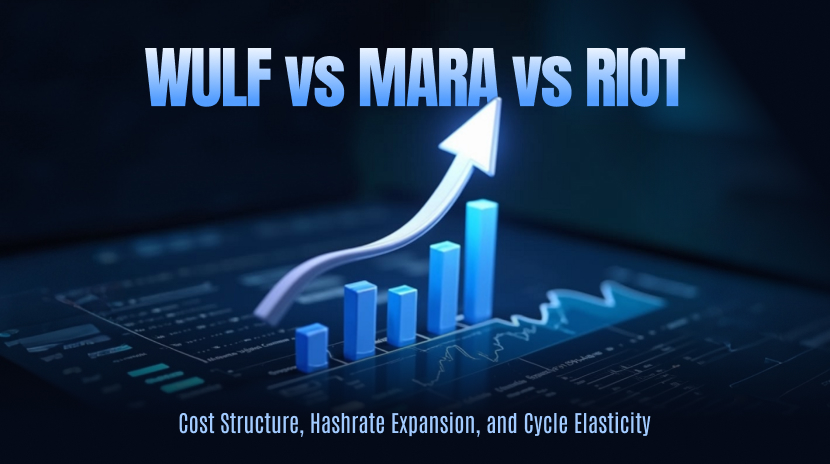
WULF, MARA, and RIOT stocks are all affected by the Bitcoin cycle, but their key differences stem from three strategic paths: unit cost control, expansion pace, and capital structure. WULF prioritizes synergy between power and energy efficiency, MARA focuses on large-scale growth and flexible asset allocation, while RIOT emphasizes infrastructure operations and capacity delivery. Examining costs, expansion, flexibility, and constraints within a unified framework explains why these stocks exhibit divergent volatility during the same cycle.
2026-11-04 08:14:48
Global financial infrastructure is steadily advancing toward tokenization and digitization. Cross-border payments are transitioning from traditional bank settlement models to innovative frameworks that incorporate blockchain technology and shared ledgers. Project Agorá, an important research initiative spearheaded by the Bank for International Settlements (BIS) alongside several central banks and financial institutions, is dedicated not only to enhancing payment efficiency, but also to building a next-generation cross-border payments ecosystem that upholds both financial stability and regulatory compliance.
2026-11-04 08:14:46
Vistra Corp (VST) operates on a three-tier business model: “generation assets—power market—retail customers.” Its generation portfolio, totaling around 44,000 MW, comprises natural gas, nuclear, coal, solar, and battery storage. The Texas and East regions correspond to wholesale and capacity markets such as ERCOT and PJM, respectively. Retail brands like TXU Energy and Ambit Energy deliver electricity to end customers, while long-term power purchase agreements offer contractual stability for large-scale electricity consumers.
2026-11-04 08:14:46
When analyzing VST stocks, special attention should be paid to nuclear power unit capacity factors, ERCOT and PJM wholesale electricity prices and capacity markets, natural gas fuel costs, retail customer competition including TXU Energy, coal-fired plant retirements and capital expenditures, returns from energy storage and solar power, and Gate Stocks codes and USDT trading rules. Business metrics and trading execution risks should be reviewed independently.
2026-11-04 08:14:46
Hanmi Semiconductor stock represents the capital certificates of Hanmi Semiconductor Co., Ltd., which are listed and traded on Korea's capital market. Its core value stems from the company's semiconductor packaging equipment business and advanced manufacturing technology capabilities.
2026-11-04 08:14:46
On Gate, trading South Korea–U.S. semiconductor stocks means buying and selling these stocks via the platform's Korean stock trading module, with USDT as the pricing and settlement currency. This mechanism mirrors the traditional stock Marktpreis within the platform's trading system, so users can trade without needing a Korean securities account.
2026-11-04 08:14:46
Hanmi Semiconductor shares represent the South Korean Hanmi Semiconductor company, specializing in TC Bonder advanced packaging equipment for HBM and high-density chip stacking technologies.
2026-11-04 08:14:46