As cryptocurrency applications advance, wallets have transitioned from merely storing assets to serving as comprehensive digital financial gateways that integrate trading, yield management, and payment services. Taking BloFin Wallet as a case study, this article examines the operational model of an all-in-one cryptocurrency wallet and explores how trading, Earn, and Visa Card collectively enable a seamless capital cycle.
2026-11-04 08:15:22
Explore BloFin Wallet’s role in the Web3 financial ecosystem by examining how an all-in-one crypto wallet brings together trading, Earn yields, and payment services, delivering a complete digital asset application experience.
2026-11-04 08:15:22
As the cryptocurrency market continues its transition from asset investment toward daily financial use, users now expect wallets to offer more than just token storage. BloFin Wallet has recently launched perpetual contract trading and Visa payment card services, striving to create a comprehensive digital finance tool that seamlessly integrates trading, asset management, yield generation, and payment functionalities.
2026-11-04 08:15:21
In the first half of 2026, the crypto industry suffered nearly $1 billion in on-chain attack losses, with the Kelp DAO and Drift Protocol incidents alone resulting in about $577 million in damages. Attack methods ranged from cross-chain message forgery and social engineering to privilege hijacking and fraudulent collateral. This article reviews the main events, examines how a single attack can trigger liquidity crunches, bad debt, token price drops, and project shutdowns, and outlines the essential security metrics that both protocols and users should closely monitor.
2026-11-04 08:15:19
Prediction markets have emerged as a key direction in blockchain finance in recent years, enabling real-time data that reflects collective expectations through the judgments of market participants regarding future events. Probly, developed on TxFlow L1, leverages the TIP3 standard and on-chain settlement mechanisms to provide event markets across cryptocurrency, sports, politics, and finance.
2026-11-04 08:15:14
Probly is an on-chain prediction market application developed on TxFlow L1. By leveraging event markets, probabilistic trading, Oracle-based result verification, and automatic USDC settlement, it converts users’ forecasts about future events into actionable market signals. This article centers on the practical workflow of Probly, exploring how users engage with event markets, how varying viewpoints shape market probabilities, how event outcomes are validated via the Oracle, and how final on-chain settlements are executed. Through this analysis, readers will gain a deeper understanding of the operational distinctions between blockchain-based prediction markets and traditional information forecasting models.
2026-11-04 08:15:14
As prediction markets emerge as a major development direction for Web3 financial applications, blockchain technology is not only providing transparent transaction records but is also evolving into the foundational infrastructure for event market execution and asset settlement. Probly, serving as the second Channel on TxFlow L1 and the first market application built on the TIP3 standard, incorporates prediction markets into the multi-application financial framework of TxFlow L1. This article analyzes Probly’s role within the Web3 ecosystem, discussing how it leverages TIP3, Channel architecture, and TxFlow L1’s shared infrastructure to bridge prediction markets with other on-chain financial products. It also assesses the potential impact of this architecture on the future development of the on-chain financial ecosystem.
2026-11-04 08:15:14
Squid (QUID) is a cross-chain liquidity infrastructure protocol developed on the Axelar network. Its main objective is to bridge diverse blockchain ecosystems, facilitating seamless interoperability between users, assets, and applications. Leveraging cross-chain swap routing, smart contract invocation, and a unified liquidity layer, Squid seeks to minimize asset transfer costs in multi-chain environments, empowering users to efficiently conduct transactions and engage with applications across multiple networks.
2026-11-04 08:15:14
Squid is a cross-chain routing infrastructure developed on the Axelar network. Its primary purpose is to connect various blockchain ecosystems, facilitating multi-chain asset swaps and application interoperability via cross-chain communication, liquidity routing, and transaction execution mechanisms. Unlike conventional cross-chain bridges that mainly solve asset transfer issues, Squid places greater emphasis on streamlining user cross-chain operations, delivering an interaction experience between blockchains that closely resembles single-chain functionality.
2026-11-04 08:15:14
Coldcard is a hardware wallet designed for secure Bitcoin storage, minimizing digital asset theft risks through offline signing, private key isolation, and secure chip architecture. In 2026, a Coldcard wallet security event attracted significant market attention; certain impacted wallets contained vulnerabilities in the key generation phase, enabling attackers to derive specific private keys and move on-chain assets. This event underscores that even hardware wallets within self-custody frameworks remain dependent on cryptographic implementation, software integrity, random number generation, and the user's security management proficiency.
2026-11-04 08:15:13
Immersion Cooling is an advanced cooling technology that dissipates heat by directly immersing computing devices in an insulating cooling liquid. By improving heat transfer efficiency, reducing thermal stress on equipment, and supporting higher computing density, it delivers next-generation infrastructure solutions for Bitcoin Farm, high-performance computing (HPC), and artificial intelligence (AI) data centers.
2026-11-04 08:15:13
Mnemonic phrases serve as the primary recovery credentials for Self-Custody. If they are lost or exposed, digital assets may be permanently unrecoverable or transferred by unauthorized parties. This article examines the key security risks associated with backing up mnemonic phrases, such as paper storage, single-point backups, device loss, and manual management. Additionally, it discusses how UKey Seed Ring utilizes NFC technology, non-plaintext storage, and functional separation to deliver a backup solution that diverges from conventional practices.
2026-11-04 08:15:11
Secure storage of mnemonic phrases remains a key challenge in cryptocurrency self-custody. UKey's Seed Ring, designed as an NFC ring for everyday wear, provides a backup solution intended to improve both the convenience and security of mnemonic phrase storage.
2026-11-04 08:15:11
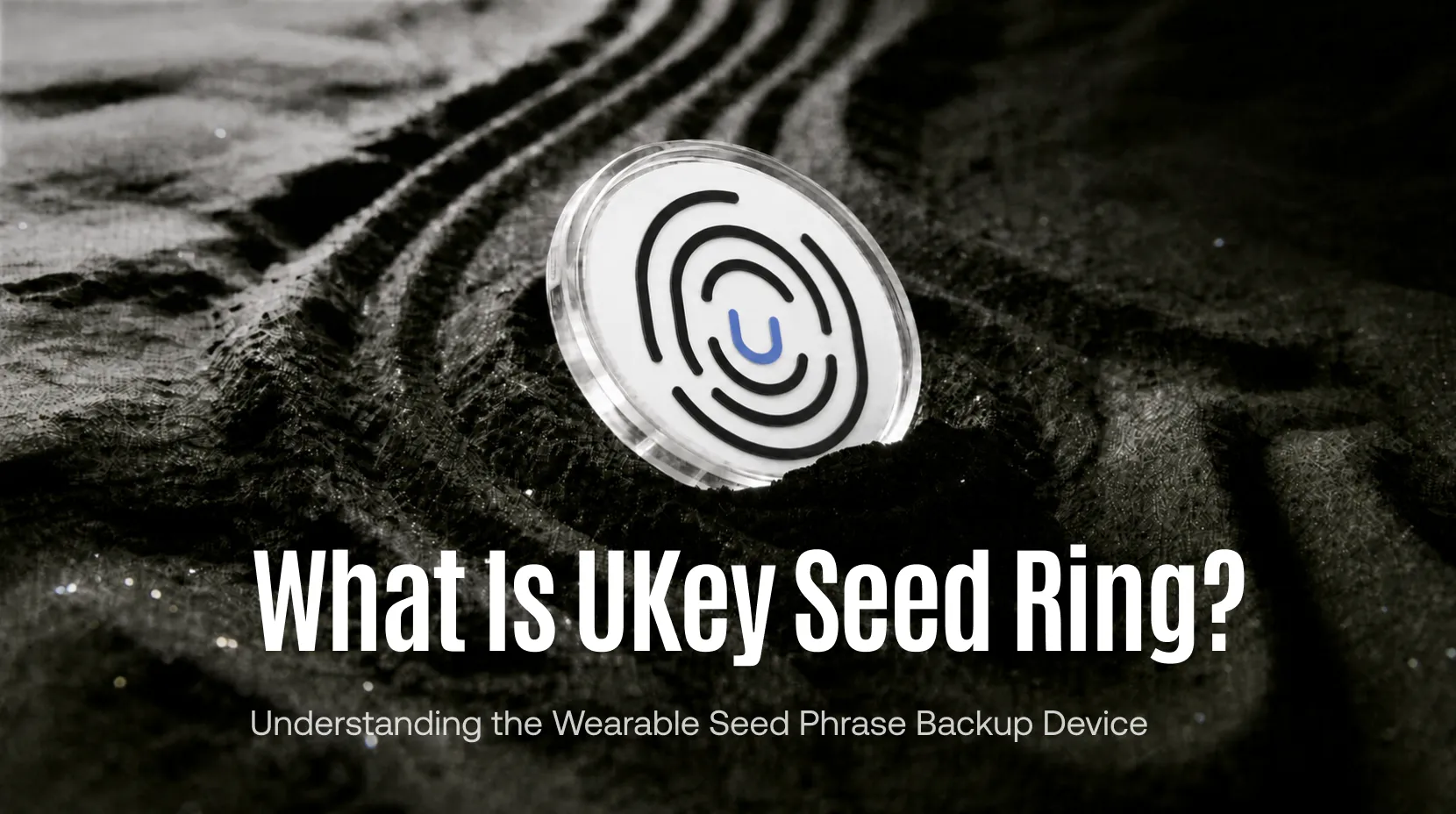
UKey Seed Ring is a wearable device engineered for securely backing up mnemonic phrases. It utilizes NFC technology, a battery-free structure, and a unique data storage system to strengthen the security of Self-Custody wallets.
2026-11-04 08:15:11
The continued convergence of the sharing economy and Web3 technology is fueling new and innovative applications for asset sharing. ivault, a peer-to-peer lending platform based in Switzerland, utilizes blockchain verification mechanisms, non-custodial wallets, and a sharing economy model to enable users to securely rent, lend, or sell items.
2026-11-04 08:15:10